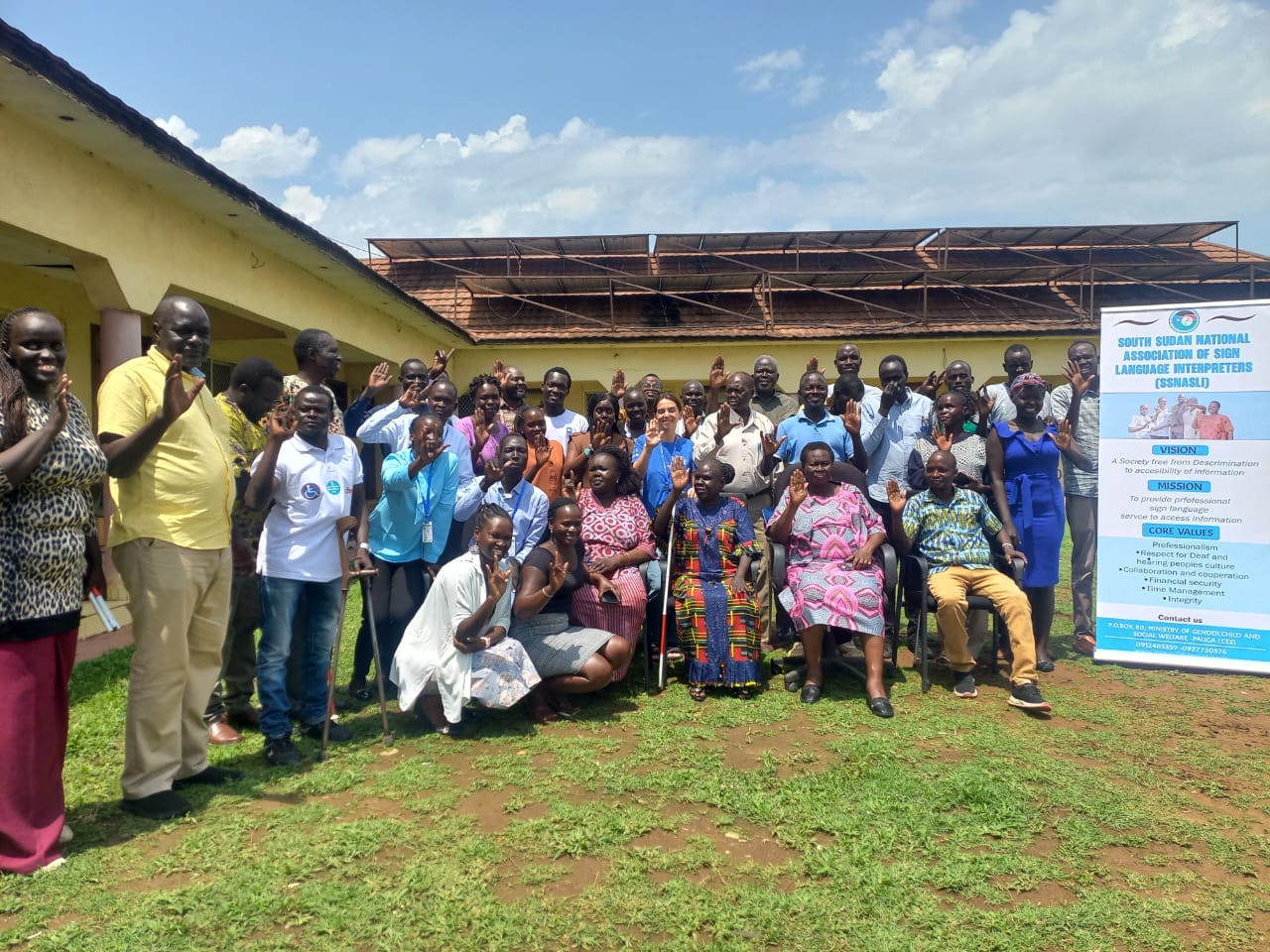
First South Sudan National Association of Sign Language Interpreters (SSNASLI) launched with the aim at advancing inclusion, accessibility, and equal communication for the Deaf community across the country.
The launch event brought together government officials, representatives from the Deaf community, development partners, civil society organizations, and members of the media under the theme: “Breaking Communication Barriers: Promoting Inclusion Through Sign Language Interpretation in South Sudan.”
The Chairperson of South Sudan Launches National Association of Sign Language Interpreters (SSNASLI) Sebit Juliano Lado said the association will enable and promote professional standards in sign language interpretation, provide training and certification for interpreters, and advocate for the integration of sign language services in public and private institutions nationwide.
“This is the beginning of a movement for inclusion, dignity, and equal communication for all,” said Sebit Juliano Lado. “Communication is a fundamental human right, and no one should be left behind.”
“There is urgent need to address communication barriers faced by deaf individuals in accessing essential services such as education, healthcare, justice, and employment,” he said.
The Chairperson of South Sudan Launches National Association of Sign Language Interpreters (SSNASLI) Sebit Juliano Lado calls upon the Government of South Sudan, donors, NGOs, and the private sector to support the association to fulfil its mission and collaborate in building an inclusive society where all citizens can fully participate.
South Sudan National Union of the Deaf of Hearing Impairment Peter Kachinga said the interpreter association will help interpreters advocate for those with hearing impairment hence bringing hope for improved communication access and recognition of their rights.
“There is a lack of sign language interpreters. Access to information becomes a bigger gap, even for these children learning in schools. To implement the inclusion, we need to bring the society together where the language will be known,” he said.
“We have the right to participate and give opinions.
Magret Mathiang, representative of NGO from UNDP, stated that the sign language interpreters link those living with disability with partners to enable understanding of the circumstances.
“Our sign language is not fully-fledged. The association should not be left behind,” she stated, emphasizing the need for partners’ commitment to support persons living with disability,” she urged highlighting the critical role interpreter’s play in bridging communication gaps.
Director of persons living with disability in South Sudan Emmanuel Lubari persons with earing impairment have been left behind, mainly due to few or no professional interpreters.
“We only have one school for interpreters. Not accessing health, education, justice, and more services,” urging people to join the association to enable exclusive access to information.
“This body that we are launching today should plan, train, educate the association and its activities,” said Lubari.
The director General for Social Welfare at the Ministry of Gender Child and Social Welfare, Regina Ossa Lullo said the association will work to promote the welfare of persons with easing impairment, the profession development, collaboration with government , and awareness about inclusive development in South Sudan
The government said it’s planning to establish the unit for persons living with disability for inclusion purposes.
“We need to increase the numbers of translators so that those that need services can get without being excluded,” she stated, citing the challenges faced by persons with disabilities face when accessing health care.
She called on the partners to collaborate with the government to support persons living with disability, support rehabilitation center to protect the vulnerable people.
“We as a government are working towards social inclusion and justice,” she said.
The ministry reaffirmed its commitment to work closely with development partners, and civil society organizations to ensure that deaf individuals have equal access to information and services.
The Ministry of Gender under the directorate of Social Welfare also launched the models for training for sign language interpreters and the Constitution for sign language interpreters of South Sudan.
The initiative was organised by persons with disability in collaboration with the national ministry Gender, Child, and Social Welfare under the them “Promoting Inclusion through signs language interpreters South Sudan.
The association will work closely with government ministries, development partners, and civil society organizations to ensure that deaf individuals have equal access to information and services.